
As is our custom, the New Art Examiner sent two reviewers to cover this fair, a staple in the Chicago contemporary art scene for more than 40 years. Below are Evan Carter’s and Michel Ségard’s perceptions of the fair.
Cultural capital is pretty much just capital now
by Evan Carter
We report on every iteration of EXPO Chicago. Since little changes year to year, it seems appropriate this time to treat the event as a snapshot of the contemporary art market and the role the Midwest plays in it.
EXPO has gradually shifted from the presentation of a broad scope of materials, methods, and scale to a painting salon with galleries and artists both functioning as the participants.
It is unlikely that we will encounter sights and experiences akin to what was presented in the earliest iterations of EXPO Chicago. Activities like Tarot Card readings by Rhonda Wheatley or a floor-to-ceiling sculpture of colorful laundry baskets by Jessica Stockholder seemed to be a punny critique of the art fair itself. Pieces such as these skewed away from monetary value and toward the value of cultural experience. The shift away from this kind of work is lamented by some and celebrated by others.
I ran into a friend who is an artist and professor and, to my surprise, was glad EXPO was not pretending to be something other than what it is. They were also pleased about what it does for the city in terms of cultural and economic activity. EXPO always has its haters who express disdain for an elite and capital driven art world, but this attitude tends to ignore the fact that artists need funding and support to enable them to produce work and reach an audience. The event also brings commerce to the city and activates other galleries and cultural spaces throughout Chicago.

So, what kind of work did we see? What did galleries from around the world bring to present at this salon-style event? As mentioned earlier, the works presented were almost entirely two-dimensional, consisting mostly of painting. This makes sense given that flat works are easier to transport and sell. Within this consistency of constraint, it is more interesting to consider each gallery’s approach. Chicago’s Secrist | Beach had prime real estate and used it to effectively showcase a roster of artists they represent. Secrist | Beach often presents thoughtful figurative abstraction with lively palettes that are rarely garish. Though the materials and methods differed the overall aesthetic vision of the gallery was clear. The same could not be said of other galleries presenting multiple artists. For example, Ethan Cohen Gallery displayed a hodgepodge of mixed media works that evoke the kind of art experience one might encounter at a mid-tier mall kiosk. These kinds of thrown together displays were rather common and had a diminishing effect on the respective artists’ whose voices felt muted. For a gallery with two locations in New York and a penchant for exhibiting politically charged work, their curatorial voice and vision also seemed lost.

Some works, like Devan Shimoyama’s Le Monde at New York’s De Buck Gallery booth, managed to stand out in these situations. De Buck Gallery also packed many works into a small space. However, it is important to note that galleries have difficult decisions to make in choosing what to ship. Their concern may be making up the cost of participation in an art fair with a high buy in. According to the EXPO website, the smallest booths (400 square feet) start at $26,400 and the largest (1000 square feet) at $66,000.

These price points are nothing for the heavy hitters like Hauser & Wirth and David Zwirner, who currently dominate the already domineering New York art market. Hauser & Wirth profited handsomely from sales of paintings by Lorna Simpson that sold for close to $300,000 each. With five locations in capital art cities around the globe, Lisson Gallery also pulled in six figure sales from works by Stanley Whitney and Carmen Herrera. Early sales figures by even the most high-profile Chicago galleries were significant but hardly equivalent, according to artsy.net. It begs the question of how well other local and international galleries fared in their endeavors to reach a wider audience. There were a few of those that stood out not just for the quality of work displayed but also because the galleries made the choice to represent single artists at their booths.
Here are just a few:
Scott Wolniak—Goldfinch
Goldfinch, one of Chicago’s younger galleries, is adept at striking a balance between traditional media and innovative ideas. In recent years, longtime Chicago painter Scott Wolniak has found a creative rhythm that has yielded what could be his definitive body of work. He does what so few others (if any) do these days–lending modes of abstraction, figuration, pattern, color, and symbolism with a playful kind of effortlessness that produces images that have the capacity to pull the viewer away from the turmoil of the world without being overly escapist. If anything is left to be desired in this work, it is relative to the constraints placed upon the medium of paint. Layers of thin washes are predominant, but interesting things could happen if the material were to be handled with a more expansive range. Perhaps it will be in future work.

Jacob Feige—Pentimenti
Pittsburgh’s Pentimenti Gallery presented a series of works by artist Jacob Feige whose abstract portraits of nameless ambiguous faces have a distinctly iconic quality. Even without discussing them with a gallery representative, these otherworldly iconographic mixed media works are clear byproducts of the digital age. They are almost like cubist self-portraits, made by Artificial Intelligence to be displayed in empty concrete hallways where no humans travel. The “freestanding quality” of these pieces is another interesting aspect that allows the viewer to see both sides of the work. Feige seems to be playing with the idea of what is “finished”—revealing a bit of the process of how the work is made while also exploring, and perhaps even raising doubt on the artists’ authority over their own work. As interesting as these works are, they seem to be the beginnings of something that is yet to be fully realized.

Yoo Suntai—Galerie GAIA
Though multiple artists were shown at this booth, one in particular stood out, albeit in a quiet way. Yoo Suntai’s series of paintings, “The Words,” harken back to a tradition within surrealism that encapsulates both dreamlike imagery and subjects along with meticulous rendering. These are not mere throwbacks though. There are a few twenty-first-century hallmarks, some more overt than others. It is difficult to imagine these compositions existing prior to the digital age. One piece depicting floating platforms has an illusionism that is both dreamlike and futuristic in how it alludes to minimalist architecture. Others in the series feature variations of a yellow interior with checkerboard floors. With debatable success, the artist carries out a subtle act of defiance against the preciousness of his own work by writing “the words” repeatedly in a pattern over the surface of the painting. The marks are so light that preciousness prevailed. Nevertheless, these pieces were some of the most memorable at the fair.

John Behnke—Project Onward
Project Onward is a platform and venue for artists with disabilities and/or mental illness. But does this even matter in the world of contemporary art? For funding and supporting artists, yes. For judging the quality of the work, not really. This is especially true for John Behnke’s “False Guides” and “The Wanderers” series at EXPO. These vibrant and detailed paintings (accompanied by some small sculpture) portray post-apocalyptic futurist narratives of defunct robot citizens and a spiritual commune of humans and fairy-like beings. There is something so boldly ham-fisted and beautifully silly about these pieces that must be celebrated alongside the pure dedication and devotion to the narrative being presented. This work lacks the formal pretension or self-aware rebelliousness that seems to define the commercial art world. Narrative itself is often derided in the art world, and though Behnke’s illustrative style may not be for everyone, this presentation stood out as a breath of fresh air.

Evan Carter is a visual artist, writer, and Associate Editor at the New Art Examiner. He received and MFA from the University of Chicago and a BFA from Massachusetts College of Art & Design.
Fiber Works the Stars of the Show
by Michel Ségard
This year’s Expo Chicago had more than the usual number of fiber pieces. We are not talking about 1960s macramé or traditional weaving; this fair showed unorthodox and innovative works using fiber in unconventional ways that echoed past past fiber artists like Adela Akers, Yvonne Pacanovsky Bobrowicz, and Claire Zeisler The use of this medium continues to be dominated by women, but as seen in this year’s fair, Nathan Vincent breaks that monopoly.
The star artwork of this category was Kandy Lopez’s City Girls at the ACA Galleries booth. This 102 by 168 inch piece stole the show not only by its size, but in how yarn is used as if it were paint. Lopez became allergic to the paints she used so she searched for a new medium and found colored yarn. Although fiber as a color medium has been done in a variety of ways in the past, Lopez uses fiber to capture the sense of impasto that one sees in heavily applied paint. This gives her work an energy not seen in other yarn techniques.

The other fiber piece that created a “splash” was Locker Room by Nathan Vincent at the Walter Maciel Gallery booth. This highly amusing piece becomes even funnier when one realizes that it is made of yarn knit over supporting structures that suggest the contents of a typical locker room. The concept of life-size lockers, showers, and urinals knitted by a man is so ridiculous that it good naturedly forces us to question our assumptions about masculinity.

John Paul Morabito’s I Need Someone to Love Tonight, shown by Patricia Sweetow Gallery that specializes in fiber work, is more serious. Morabito creates large hanging tapestries where the top strip of the work is traditionally woven, but the warp is left to hang free after about a foot. The fibers are then encrusted with beads and embellished with gold leaf thread. Their work also references Catholic liturgical tapestries. For me, Morabito’s piece also calls up memories of a beaded curtain in the entry to a secret cabaret in a 1940s movie. What is on the other side of that portal? In that some of his works are in memory of friends who died of AIDS, maybe the portal is to a more serene existence.

A piece that had a similar form, but entirely different aesthetic, was Jacqueline Surrell’s Golden Fleece at the Secrist | Beach booth. Her large yellow and lavender wall hanging also had a fully crafted top with long “warp” pieces hanging to the floor. Hers, however, was assembled using knot work somewhat reminiscent of macramé, but much bolder, even aggressive. In her piece, there is a “window” in the center of the top portion that is framed with an arch shaped series of knots. Strangely, it has a gothic, ecclesiastical feel. Strangely, both Surrell’s and Morabito’s works have suggestions of gateways to otherworldly existence.

Another piece that played with the warp of a weaving was Aiko Tezuka’s Closing and Opening (A Study of Bravery) –Friction. Tezuka designs and weaves her own fully executed Jacquard weavings, carefully controlling the colors of the warp fibers. Then she extends the warps from two weavings and braids them together into a kind of web. It makes for a very elegant, but unexpectedly surreal, work.

There were a number of works woven with unusual materials that illustrated how far the concept of weaving has developed. Two of them are El Anatsui’s Profile, fashioned from aluminum and copper wire, and Kenny Nguyen’s Eruption Series No. 85, made with hand-cut silk fabric, acrylic paint, and canvas. Neither of these works are small; Anatsui’s is a whopping 120 x 104 inches while Nguyen’s is a mere 70 x 90 inches. When it comes to weaving, it seems that size matters.

Other Works that Caught my Eye
Although weaving was the trend that captured my attention, there were a number of other works that deserve mention—pieces varying from plasma cut metal sculptures to traditional paintings. Cal Lane, a Canadian sculptor represented by C24 Gallery, takes old ammunition boxes and cuts them into lacy wall hangings that look like they could hold hanging plants.

On a larger scale, Jaeha Lyu’s Mind Others, presented by 021 Gallery, showed a dramatic combination of mechanization and electronics. This ensemble consists of seven mechanized units that slowly open and close like apertures in a camera to reveal small video screens in back. The slow, almost unnoticeable, random modulation gives the piece the illusion of being alive.

Nik Cho had a large painting at the Secrist | Beach booth called Big Bertha (Gathering) that really attracted notice. It depicts five young men standing around who look almost exactly alike yet are dressed in different clothes. On the right, a slightly larger older looking man stands staring at them. Surprisingly, the blue-orange-green color palette is not garish. Two men in the group appear to be holding hands, and another has his hand on the shoulder of his neighbor. Is the older man on the right showing disapproval of the latent intimacy of the pairs? And why do they all look alike? There is a definite air of melancholy or sadness to the whole scene.

ONE AND J. Gallery from Seoul presented six small, abstract, geometric variations on a theme. Displayed in a row at eye level, the works made an engaging swath of color across one wall of the booth. They had the same deep rich colors of Hugh Byrne’s three large pieces that were shown at the Ebony Curated booth in 2023. It is refreshing to see that geometric abstraction is still being explored. The intimate scale of this ensemble makes them all the more enjoyable.

The last two works that caught my attention resonated with each other, although they were nowhere near each other at the fair. This is one thing that fairs are good for—you sometimes get to consider and compare works that you would not normally see in the same setting. In this case, the story of twentieth-century Black America is unexpectedly encapsulated through these two artworks.
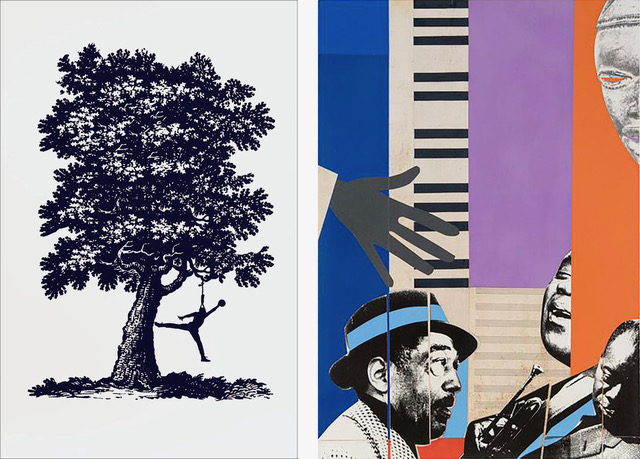
Overall, Expo Chicago 2025 can be considered a “safe” fair. Fiber was the medium that stood out for me this year. And there were a few provocative exhibits that mostly had to do with challenging our cultures traditional sexual roless. A man should not be knitting, much less an entire locker room—why not? A woman should not be a welder using a plasma cutter—why not? Given the fair’s size, there are always a number of pieces which are just plain beautiful.
So, should such fairs continue to be held? Yes, they show what is going on in the mainstream market and, occasionally, give us a glimpse into the future. Expo Chicago 2025 satisfied both of those criteria.
Michel Ségard is the Editor in Chief of the New Art Examiner and a former adjunct assistant professor at the School of the Art Institute of Chicago. He has been a published art critic for more than 45 years and is also the author of numerous exhibition catalog essays.